Loading live airspace incident & technology intelligence...
Sovereign Airspace IntelligenceCanadian-Engineered
DefendX TechnologiesMultiple Sensors One Fused IntelligenceZero Blind Spots SkyShield Protection
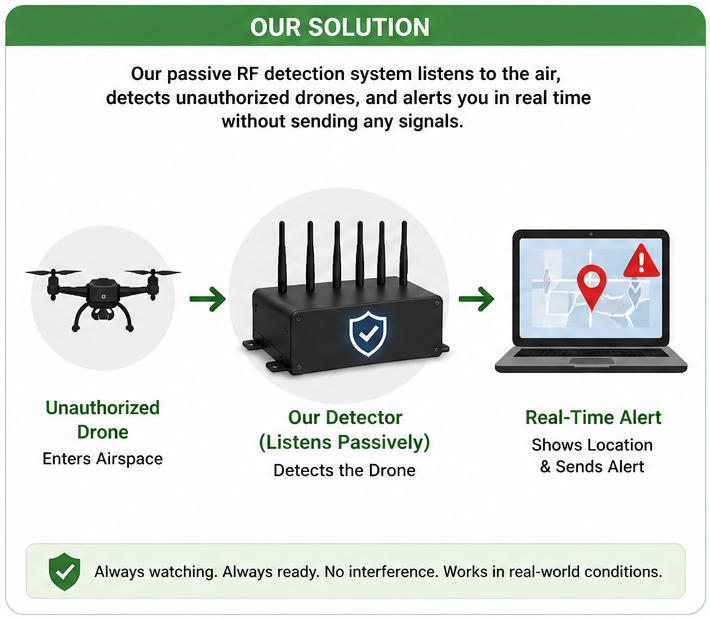
DefendX Technologies delivers an edge-autonomous UAV sensing system that continuously monitors the radio-frequency spectrum to intelligently detect, identify, classify, and track unauthorized drones in real time.
Brand-named AirSentinel-CA™, this platform transforms complex RF signals into low-latency, actionable intelligence. By processing data entirely on-site, it ensures minimal data dependency, seamless scalability, and resilient performance in contested or completely disconnected environments.
Engineered for mission-ready airspace security, AirSentinel™ empowers organizations to detect drone threats earlier, respond faster, and protect critical infrastructure with confidence. Designed for Canada’s most demanding security environments, it safeguards airports, correctional facilities, power grids, border crossings, and major public events nationwide—even under extreme temperatures and in fully off-grid deployments.
Aviation Incursions recorded near Canadian runways in a single year—growing past 30% annually.
1,064
Correctional Breaches recorded nationally. Contraband drops increased tenfold over 5 years.
26,000 km
Energy Utility Corridors spanning Canada currently operating with zero real-time airspace visibility.
90%+
Vulnerability Gap across critical infrastructure sites, including airports, refineries, and grids currently lacking layered C-UAS protection.
Sectors & Deployments
Enterprise Solutions Architecture
AirSentinel is built for environments where drone activity creates operational, financial, and reputational risk. The platform combines passive RF sensing, edge AI, and real-time alerting to help organizations detect, classify, and understand threats without the deployment friction and safety drawbacks of conventional counter-drone tools.
Public Mobility Hubs (Focus: Canadian Aviation Framework)
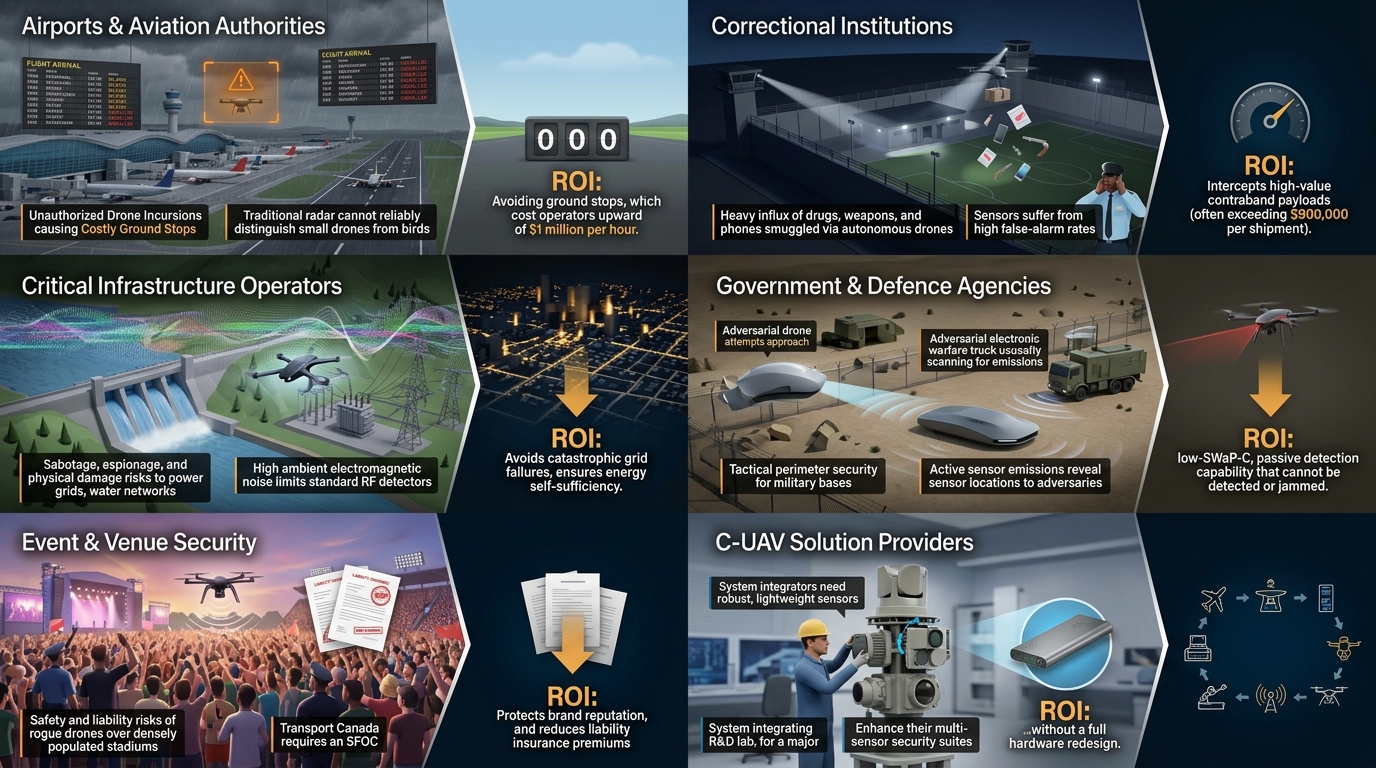
Airports, stadiums, arenas, and transit-adjacent venues are among the most visible and disruption-sensitive airspace environments. In Canada, unauthorized drone loitering near commercial flight paths has followed an aggressive upward trend. Transport Canada has documented hundreds of hazardous incidents annually, putting immediate pressure on airport operators to establish real-time vertical situational awareness.
+140% Spike
YoY increase in unauthorized sUAV near-miss operations inside controlled Canadian Class C airspace corridors.
$250K / Hr
Average structural cascading loss during emergency runway lockdowns and tactical delays.
🔴 High-Profile Incidents & Media Impacts
Toronto Pearson International Airport (YYZ): Multiple localized ground stops were triggered by rogue drone loitering over critical approach paths, drawing intense national media scrutiny, disrupting thousands of travelers, and highlighting severe industrial vulnerability gaps.
Vancouver International Airport (YVR): Repeated near-miss proximity encounters recorded below 450 meters by commercial flight crews during final descent segments, prompting joint federal taskforce investigations and urgent mandates for passive RF infrastructure deployments.
⚠️ Legacy Limitations
Conventional systems often struggle here because active countermeasures can create safety concerns near commercial aviation, while standalone radar or visual tools can be defeated by clutter, false alarms, or low-altitude flight profiles.
🛡️ The DefendX AirSentinel™ Advantage
AirSentinel gives operators a passive, deployable detection layer that improves response speed while avoiding airspace-disruptive mitigation methods, which is a strong fit for airport authorities, venue operators, and infrastructure investors.
Utility and Energy Corridors
Power grids, substations, pipelines, refineries, and related energy assets need constant awareness because drone reconnaissance can expose vulnerabilities long before a physical attack occurs. In Canada, remote hydro-generation assets, nuclear plants, and oil sands delivery paths have experienced an increasing trend in unidentified sUAV scouting loiters.
65% Rise
Increase in anomalous low-altitude signatures tracked over sensitive national grid hubs.
🔴 Threat Scenarios & Industrial Espionage
Mapping of facilities, line-of-sight intelligence gathering, package delivery near restricted assets, and coordinated disruption of distributed energy operations. Media profiles have drawn attention to unknown drone operators recording thermal telemetry over regional transmission infrastructure, raising espionage concerns at corporate levels.
⚠️ Legacy Limitations
Conventional counter-drone solutions often fail in this setting because wide-area sites are difficult to cover with one sensor type, and active jamming or kinetic response can be operationally risky around critical systems.
🛡️ The DefendX AirSentinel™ Advantage
AirSentinel is positioned as a low-friction, scalable detection layer for utilities that want persistent visibility, better incident attribution, and a stronger risk story for regulators, insurers, and investors.
Civic Landmarks and Urban Assets
Government buildings, civic centers, landmarks, and municipal complexes face drone threats that are as much about disruption and symbolism as direct damage. Dense urban RF conditions make detection harder and public concern higher. Uncoordinated flights near symbolic Canadian architectures have emphasized the need for discrete perimeter verification.
🔴 Threat Scenarios
Unauthorized filming, protest activity, nuisance overflights, and drone-borne surveillance of entrances, windows, and security routines.
⚠️ Legacy Limitations
Conventional tools can be limited by clutter, line-of-sight issues, and the legal sensitivity of deploying active mitigation in dense urban space.
🛡️ The DefendX AirSentinel™ Advantage
AirSentinel offers civic operators a passive intelligence layer that supports safer decision-making, lower operational disruption, and a more defensible procurement case for city governments and public agencies.
Correctional and Restricted Sites (Focus: Canadian Prison Contraband Epidemic)
Prisons and detention facilities are now one of the clearest proof points for drone-enabled contraband delivery. Correctional Service Canada (CSC) faces an organized challenge as criminal rings deploy multi-rotor drones to bypass high-security walls, bringing severe disruption to yard perimeters.
300% Spike
YoY surge in documented nighttime drone drop maneuvers intercepted across federal institutions.
$28M+ Budget
Capital allocated by regional authorities for multi-layered perimeter counter-drone systems.
The Kingston Correctional Cluster Incident: A major coordinated drone smuggling operation targeted multiple maximum-security prisons in the Kingston, Ontario region—notably Collins Bay Institution. Payloads holding firearms, narcotics, and communication modifications worth over $100,000 per flight led to extended facility lockdowns and emergency staff updates.
Donnacona Institution Breach: Frequent drops by modified industrial units engineered to fly through severe cold weather patterns forced immediate infrastructure revisions after contraband distributions led to security threats within the facility yards.
⚠️ Legacy Limitations
Conventional perimeter security fails because drones completely bypass ground-level arrays. Jamming methods are limited due to nearby municipal zones and strict telecommunication guidelines.
🛡️ The DefendX AirSentinel™ Advantage
AirSentinel identifies rogue operators and tracking signatures over perimeter boundaries long before the package payload drops, allowing security staff to respond rapidly.
Enterprise and Industrial Campuses
Factories, logistics parks, warehouses, data centers, and large private campuses are becoming routine targets for aerial observation and competitive intelligence collection. Airspace protection is no longer limited to military or airport use cases.
🔴 Threat Scenarios
Industrial espionage, perimeter mapping, inventory reconnaissance, surveillance of executives or logistics flows, and opportunistic nuisance flights over sensitive facilities.
⚠️ Legacy Limitations
Conventional solutions often require too much infrastructure, too much integration work, or too much operator attention to be practical across multiple sites.
🛡️ The DefendX AirSentinel™ Advantage
AirSentinel is attractive in this segment because it can scale across distributed facilities, create a common operating picture, and support subscription-style adoption across enterprise portfolios.
Media and Event Environments
Broadcast operations, concerts, sports events, and large public gatherings face elevated risk because drones can intrude on live coverage, crowd safety, and temporary event infrastructure. Trends across major venues highlight a growing willingness of authorities to restrict drones when threat levels rise.
🔴 Threat Scenarios
Unauthorized filming, distraction of security teams, unsafe proximity to performers or crowds, and intentional disruption of live broadcasts.
⚠️ Legacy Limitations
Conventional systems are often too slow to deploy, too noisy to operate, or too operationally heavy for temporary venues and fast-moving event schedules.
🛡️ The DefendX AirSentinel™ Advantage
AirSentinel gives event operators and media security teams a deployable detection solution that can be brought in quickly, then removed cleanly when the event ends.
Maritime and Coastal Operations
Ports, harbors, coastal terminals, offshore assets, and marine logistics corridors are vulnerable because drones can support surveillance, smuggling, and coordination for air-sea hybrid threats. Airspace and maritime security are converging.
🔴 Threat Scenarios
Surveillance of port operations, package drops, mapping of harbor layouts, interference with loading activity, and support for broader maritime sabotage campaigns.
⚠️ Legacy Limitations
Conventional systems often fail because coastal environments combine reflection, clutter, weather complexity, and large coverage areas that are difficult to monitor with one sensor layer.
🛡️ The DefendX AirSentinel™ Advantage
AirSentinel offers maritime operators a flexible awareness layer that can support terminals, fuel depots, and offshore-adjacent facilities with earlier warning and better incident intelligence.
Border and Perimeter Security
Border zones, remote crossings, and long perimeters are among the most operationally difficult environments for counter-drone work. Perimeter incidents show how quickly drone responses can become sensitive when active mitigation methods are used near civilian lines.
🔴 Threat Scenarios
Transnational reconnaissance, package drops, cross-border surveillance, diversion tactics, and airspace confusion that can affect both law enforcement and commercial traffic.
⚠️ Legacy Limitations
Conventional solutions are limited because they can be difficult to authorize, easy to overreact with, and risky when they create aviation disruption or misidentification.
🛡️ The DefendX AirSentinel™ Advantage
AirSentinel is compelling here because it supports detection-first workflows, early attribution, and scalable monitoring without forcing immediate active engagement.
Protective Detail Operations
VIP protection, executive movement, convoy security, and temporary close-protection missions need fast, portable counter-drone awareness. A single drone can create a significant operational or reputational event.
🔴 Threat Scenarios
Filming of movements, route reconnaissance, distraction over staging areas, and payload delivery near protected persons.
⚠️ Legacy Limitations
Conventional systems are often too fixed, too slow to stage, or too dependent on large infrastructure to fit protective detail operations.
🛡️ The DefendX AirSentinel™ Advantage
AirSentinel is better suited because it can be deployed rapidly, integrated into mobile security planning, and used to support command teams without adding unnecessary complexity.
National Defense and Special Operations
National security, homeland security, military bases, and special operations environments represent the high-end sector of the counter-drone market. Defense guidelines focus closely on maintaining multi-layered passive detection capabilities to counteract coordinated low-altitude intelligence collection cycles.
🔴 Threat Scenarios
Reconnaissance, swarm probing, payload delivery, base mapping, and hostile surveillance of personnel or infrastructure.
⚠️ Legacy Limitations
Conventional systems remain limited because no single sensor or mitigation method is reliable across every mission, and active effects can raise safety, policy, or collateral concerns.
🛡️ The DefendX AirSentinel™ Advantage
AirSentinel gives defense buyers a resilient passive layer that improves early warning, supports layered architectures, and strengthens mission readiness without requiring immediate dependence on disruptive countermeasures.
AirSentinel™ targets high-value verticals where real-time airspace intelligence delivers immediate economic and operational protection. Each sector is strategically prioritized based on market urgency, revenue potential, regulatory drivers, and seamless alignment with mission-critical security infrastructures.
Correctional Facilities & Justice Infrastructure
Preventing automated contraband delivery and perimeter breaches. Correctional facilities represent highly critical immediate operational risk zones where unauthorized sUAV flights bypass physical architectures.
Priority Tier 1
Immediate allocation and budget scaling vertical for perimeter systems.
Critical Urgency
High-frequency recurring manual dropping hazards intercepted at perimeter walls.
🔴 Market Intelligence Overview
Who Buys: Federal and state/provincial corrections procurement boards, institutional wardens, and enterprise perimeter infrastructure security directors.
Why They Buy: To eliminate the immediate financial, legal, and operational risks of automated contraband delivery systems bypassing traditional physical walls.
⚠️ Operational Context & Commercial Framework
Context: Continuous, low-altitude perimeter monitoring across small geographic boundaries. The edge-AI platform filters out regular urban background noise to track delivery drones instantly.
Commercialization: High-margin, highly repeatable regional contracts. Generated through hardware sales or multi-year Perimeter-Security-as-a-Service (PSaaS) leases, combined with recurring software subscriptions.
🛡️ The DefendX AirSentinel™ Advantage
This platform is ideal for correctional facilities facing active perimeter breaches that need to intercept illegal drone drops without disrupting local institutional communications.
Aviation & Public Mobility Hubs
Securing flight corridors and active runways from grounding delays. Intrusions into commercial logistics spaces cause systematic operational stop-shocks.
Mitigating catastrophic mid-air collisions and cascading ground vector stops.
🔴 Market Intelligence Overview
Who Buys: Airport authorities, tier-1 commercial aviation safety directors, and national transportation safety regulators.
Why They Buy: To avoid massive financial losses from ground delays, flight diversions, and catastrophic mid-air collisions caused by unauthorized drone activity in restricted airspace.
⚠️ Operational Context & Commercial Framework
Context: Wide-area monitoring across active runways, flight paths, and approach corridors. The system operates completely passively to ensure zero interference with critical airport radar or navigation.
Commercialization: Multi-million dollar enterprise capital expenditure (CapEx) contracts or multi-year software-as-a-service (SaaS) frameworks that shorten integration timelines from years to weeks.
🛡️ The DefendX AirSentinel™ Advantage
This platform is ideal for major commercial airports that require continuous, long-range drone monitoring without risking interference with active flight systems.
Stadiums, Arenas, & Large-Scale Mass Gatherings
Protecting commercial airspaces, live broadcasts, and large crowds from rogue telemetry interceptions or kinetic delivery events.
Priority Tier 2
High commercial capture potential with event-driven dynamic matrix structures.
High Urgency
Ensuring broadcast safety clearances and stadium physical security guarantees.
🔴 Market Intelligence Overview
Who Buys: Vice Presidents of Venue Operations, Stadium Security Directors, and Executive Producers of major public events and high-value sports broadcasts.
Why They Buy: To safeguard packed stadium crowds from airborne physical threats, prevent unauthorized event filming, and eliminate the risk of an unapproved drone grounding a high-value live broadcast.
⚠️ Operational Context & Commercial Framework
Context: High-density RF environments during event days. The system accurately filters out urban noise to isolate unauthorized drone control signals instantly without disrupting venue communications.
Commercialization: A lucrative mix of permanent venue infrastructure integration and predictable, high-margin, event-based equipment leasing models (Mitigation-as-a-Service / MaaS).
🛡️ The DefendX AirSentinel™ Advantage
This platform is ideal for high-capacity entertainment and sports venues that require immediate, low-false-alarm drone tracking across dense, RF-heavy metropolitan crowds.
Energy, Utilities, & Nuclear Infrastructure
Defending remote power grids, nuclear facilities, and refineries. Protecting national lifelines from surveillance and disruptive drone incursions.
Priority Tier 2
Vast scale-out integration horizons across state and enterprise assets.
High Urgency
Mitigating grid downtime risks and dangerous payload threats over critical equipment.
🔴 Market Intelligence Overview
Who Buys: Corporate security heads, chief risk officers, and critical infrastructure protection teams at power stations, refineries, and water treatment plants.
Why They Buy: To defend against corporate espionage, physical damage to critical machinery, and intentional drops of hazardous payloads that can compromise public safety grids.
⚠️ Operational Context & Commercial Framework
Context: Remote, rugged, and hazardous environments that require durable equipment able to withstand harsh weather while covering vast asset footprints.
Commercialization: Significant multi-site expansion opportunities across entire national asset networks. Low-power edge compute units run entirely on off-grid solar arrays to lower physical infrastructure costs.
🛡️ The DefendX AirSentinel™ Advantage
This platform is ideal for remote energy and utility facilities that require rugged, low-maintenance drone detection capable of operating reliably in harsh environments.
Government Buildings, Diplomatic Sites, & High-Profile Facilities
Sovereign data-compliant long-term procurement deployment matrices.
High Urgency
Defending leadership protocols and classified executive communications from monitoring.
🔴 Market Intelligence Overview
Who Buys: Federal building management services, diplomatic security teams, and national law enforcement agencies.
Why They Buy: To protect leadership personnel, classified meetings, and foreign embassies from targeted surveillance, electronic eavesdropping, and airborne perimeter violations.
⚠️ Operational Context & Commercial Framework
Context: Dense city environments packed with heavy background radio interference, demanding highly accurate signal filtering to prevent false alarms.
Commercialization: Highly stable, long-term government contracts backed by steady annual maintenance allocations. Processes all signal data directly at the edge to ensure maximum security protocol compliance.
🛡️ The DefendX AirSentinel™ Advantage
This platform is ideal for high-security government and diplomatic facilities that require discrete, passive threat detection within complex city environments.
Defense Contractors & Logistics Centers
Integrating zero-emission passive intelligence sensors into active multi-layered forward tactical defense monitoring configurations.
Priority Tier 3
Strategic long-term volume expansion and multi-year defense roadmap integration.
Strategic Growth
Rugged network configurations built for operational safety footprints.
🔴 Market Intelligence Overview
Who Buys: Base defense commanders, logistics operators, and defense prime integrators.
Why They Buy: To secure supply depots, training grounds, and tactical staging areas against hostile drone surveillance and unexpected air attacks.
⚠️ Operational Context & Commercial Framework
Context: Must integrate smoothly with broader tactical military command systems (such as forward area air defense networks) and adapt to mobile deployments.
Commercialization: Massive, multi-year programmatic procurement volume. Zero-emission passive operation prevents adversaries from tracking the system using electronic warfare counter-measures.
🛡️ The DefendX AirSentinel™ Advantage
This platform is ideal for forward logistics hubs and military bases that need a light, zero-emission sensor footprint to plug into broader defense networks.
Vulnerabilities
Global Airspace Threat Landscape Architecture
Modern consumer and industrial drone capabilities are advancing faster than traditional corporate security perimeters can adapt. Airspace risk now drives decisions on commercial liability, operational disruption, and infrastructure investment across civil, industrial, and sovereign environments, creating urgent demand for scalable counter-drone intelligence.
Asymmetric Airspace Vulnerabilities: The Dual-Use Dilemma
Small Unmanned Aerial Systems (sUAVs) have evolved from recreational novelties into ubiquitous operational threats. While providing immense economic efficiencies, their structural agility allows malicious or negligent actors to completely bypass traditional terrestrial security perimeters. Low-altitude vectors present unique detection challenges due to minimized radar cross-sections.
"The democratization of advanced flight controllers means that standard physical boundaries no longer guarantee perimeter integrity."
🛰️ Airborne Espionage
Readily available high-definition optics allow unauthorized surveillance of sensitive facilities, corporate assets, and executive installations from unprotected vertical lines of sight.
📦 Contraband Delivery Vectors
Automated waypoint navigation allows payload-carrying systems to execute precise drops over correctional facility fences and across international borders, evading standard ground checkpoints.
💥 Asymmetric Sabotage
Consumer platforms can be configured to carry kinetic or electronic hazards, threatening public officials, open-loop grids, and vital energy nodes.
⚠️ Operational Incursions
Inexperienced operators flying consumer platforms routinely drift into restricted corridors, causing immediate disruptions to civil aviation hubs, traffic networks, and high-visibility public events.
The Macro-Economic Utility Landscape: Commercial & Sovereign Value
Unmanned aviation acts as a fundamental catalyst across global markets, driving down operational costs, protecting human capital, and optimizing data collection frequency. Legitimate commercial drone usage is exploding, meaning security operators must differentiate, not blindly block signals.
⚡ Industrial & Energy Logistics
Automated inspections of energy grids, transformers, and pipeline networks reduce data acquisition delay while eliminating the safety risks associated with human inspections.
🌾 Precision Digital Agriculture
Imaging payloads assess vast crop acreage, monitor livestock distribution, map irrigation deficiencies, and direct automated localized delivery with minimal soil impact.
🏗️ Civil Infrastructure & Real Estate
Construction management frameworks leverage continuous aerial modeling to assess structural layouts and track high-velocity material distributions safely.
🛡️ Sovereign Governance & Tactical Defence
First responders, border security elements, and local military units deploy localized systems for real-time terrain intelligence and search-and-rescue arrays.
Quantifying the Airspace Crisis: Empirical Trends
Data collected from international regulatory bodies, municipal registries, and proprietary signal monitoring frameworks demonstrate an undeniable trend: unauthorized low-altitude flights are growing exponentially.
3.4x
Incursion Multiplier
Validated localized tracking reports show a massive increase in uncoordinated aerial events near critical infrastructure nodes between 2023 and 2026.
At Collins Bay Institution in Kingston, Ontario — one of Canada's largest federal penitentiaries — nearly 100 unauthorized drones were intercepted in a single year, almost ten times the number recorded just five years earlier. In Quebec, staff reported 274 drones flying over provincial detention centres in just one quarter.
The Financial & Operational Liabilities of Airspace Blindness
Waiting for an explicit airborne breach to occur represents a severe organizational risk. For asset operators, corporate boards, and security managers, failing to deploy continuous monitoring tools results in direct exposure to substantial downstream liabilities.
Immediate Capital Dissipation
A minor incursion at a primary shipping port or aviation corridor forces a complete operational suspension. Idle logistics operations and diverted commercial aircraft can generate losses exceeding millions per hour.
Regulatory & Legal Exposure
Failing to maintain a documented record of low-altitude threats exposes infrastructure operators to compliance penalties, third-party liability lawsuits, and severe breaches of mandated physical security standards.
The Failure of Legacy Defensive Paradigms
Traditional corporate security methods are structurally ill-equipped to identify or counter modern consumer and custom drone threats. Legacy technologies frequently introduce severe secondary risks or suffer from significant blind spots.
Active Radar Limitations
Conventional radar arrays struggle with small physical signatures, frequently misidentifying incoming targets as ground clutter or bird activity in urban landscapes.
Active Jamming Restrictions
Active transmission counter-measures generate severe signal interference, creating major legal, regulatory, and spectrum licensing barriers near airports or commercial centers.
Technology
Comprehensive Defense-in-Depth Capability
Our multi-tier tech stack processes complex aerial environments systematically, bringing rigorous safety to corporate and government facilities.
📡
Detection
Utilizes passive radio frequency monitoring to intercept low-altitude targets without emitting active signals, eliminating licensing conflicts and local network interference.
🧬
Identification
Identifies the threat profile by matching incoming signal characteristics to a pre-configured, localized classification library, utilizing our advanced neural fingerprinting models.
📊
Classification
Differentiates harmless consumer platforms or industrial survey operations from high-priority, unauthorized targets immediately.
📍
Tracking
Maintains a continuous, secure path log of the threat's coordinates through your protected boundaries, projecting flight vectors on your maps.
🛑
Addressing
Sends real-time coordinates and threat alerts directly to security staff or central monitoring dashboards for immediate, targeted counter-UAS response.
The Solution
AirSentinel™ — Built for the Real World
AirSentinel™ is built to operate reliably in real-world environments, filtering out ambient clutter to provide clear, actionable insights for security coordinators where false alarms disrupt workflows.
By running specialized machine-learning processing directly at the edge, the AirSentinel™ platform continuously monitors low-altitude perimeters, operating independently without requiring constant external network connections or centralized infrastructure.
Three-Stage Architecture
Stage 01Passive · No Emissions
Passive RF Signal Acquisition
Wideband omnidirectional monitoring across key frequency bands. Zero electromagnetic output. Fully compliant with spectrum regulations.
↓
Stage 02Edge Deployed
Edge-Based Processing
Signal analysis runs entirely on-site. Intelligently filters out normal environmental signals and background wireless activity without cloud latency.
↓
Stage 03API · SOC Compatible
Autonomous Alert & Reporting
Real-time coordinate transfers map localized security threats. Integrates with security operations center software layers.
Sovereign Edge Engineering
Architected to Exceed Legacy Countermeasure Limits
Technical and operational design choices that ensure dependable security in highly complex enterprise environments.
Fully Passive Detection Architecture
Our systems transmit zero signals. This structural choice handles complex regulatory compliance hurdles naturally across commercial airfields, urban cores, and high-density industrial plants.
✓ Deployable where active transmission systems cannot operate
True Edge-AI Autonomy
AirSentinel™ functions entirely as an independent, standalone platform. By containing all computational workloads directly on-unit, it completely eliminates mandatory cloud data processing, round-trip processing lag, and sensitive data exposure from external raw captures.
✓ Complete data sovereignty with real-time, on-site execution
Energy-Efficient & Cost-Effective
Designed with highly optimized low-power consumption frameworks, AirSentinel™ breaks down financial and infrastructure barriers. It provides an highly affordable enterprise-grade C-UAS alternative without sacrificing military-spec reliability.
✓ Solar-compatible engineering with a highly scalable market price point
Competitive Analysis
System Capabilities vs. Market Standards
Capability
DefendX AirSentinel™
Traditional C-UAS
Basic Scanners
Passive RF Sensing (No TX)
✓ Yes
✗ No
✗ No
Zero Cloud Dependencies
✓ Yes (On-Site)
✗ No
⊘ Partial
Low Power / Solar Ready
✓ Yes
✗ No (High Draw)
✓ Yes
Affordable / Scale Pricing
✓ Yes (SaaS Available)
✗ No ($500K+ CapEx)
✓ Yes
* Drag horizontally to swipe table metrics on mobile viewports.
Knowledge Base
DefendX Intelligence Hub
Deep industry analysis, real-time threat intelligence, physical security research, and direct operational documentation for secure perimeters.
Latest Corporate News & Safety Updates
System Notice
June 2026
DefendX Digital Infrastructure Under Active Deployment
Please note that the official DefendX Technologies digital platform is currently undergoing final architecture development and optimization. As we transition our enterprise interface to full deployment, certain sections may feature placeholder frameworks or restricted access boundaries.
Parallel to this digital rollout, our engineering teams remain committed to continuous development. We are dynamically iterating our core airspace intelligence algorithms and hardware-software integrations to counter rapidly evolving aerial threats, ensuring AirSentinel™ consistently delivers resilient, next-generation protection across Canada’s critical infrastructure.
Industry Insights
Aviation & Infrastructure Intelligence
The rapid shifting of custom UAS control links requires adaptive security strategies. Keep your risk mitigation programs synchronized with emerging market trends.
The 1.4 GHz Shift
Custom commercial and security platforms are bypassing congested 2.4/5.8 GHz channels, migrating to proprietary telemetry links.
Municipal Drone Integration
How municipal security frameworks are structuring low-altitude airspaces to enable secure last-mile delivery services.
Next-Gen Swarm Dynamics
As software-defined mesh nodes emerge, security operators require passive sensors capable of multi-source spatial assessment.
C-UAS Knowledge Center
Counter-UAS Technology & Regulatory Directory
Passive RF Monitoring vs. Active Radar
Passive RF monitoring captures airborne communication links dynamically without emitting active transmission radiation, guaranteeing license-free deployment in municipal corridors. Traditional active radar systems introduce severe local interference vectors.
Spectrum Allocation Standards
Understand spectrum bands (915 MHz, 2.4 GHz, 5.8 GHz) used by commercial UAS, alongside legal limitations regarding signal disruption, Jamming vs. Passive Detection, and ISED licensing requirements.
Proprietary R&D Core
Scientific Foundations Behind AirSentinel™
DefendX Technologies is built upon years of IEEE peer-reviewed research in wireless communications, RF sensing, signal processing, UAV systems, and artificial intelligence. Our research program provides the scientific foundation for developing next-generation passive drone detection and airspace monitoring technologies designed for critical infrastructure protection.
RESEARCH & INNOVATION LEADERSHIP
Driven by Elite P.Eng. & IEEE Senior Member Engineering Teams
DefendX is backed by a dedicated powerhouse of advanced researchers, professional engineers (P.Eng.), and IEEE Senior Members at the absolute forefront of next-generation airspace security technologies. Our corporate R&D division continuously leverages peer-reviewed scientific breakthroughs, transforming complex mathematical and engineering concepts into hardened, commercially deployed protection solutions for mission-critical infrastructure.
IEEE JOURNAL PUBLICATION
Performance Analysis of Unauthorized UAV Detection Using RF Sensing Under Non-Ideal Transceiver Conditions
Research Contribution
The core mathematical foundation for the AirSentinel™ intelligence layer. This breakthrough framework introduces optimal engines that neutralize real-world sensor vulnerabilities by accurately modeling passive RF-based UAV detection under practical hardware imperfections. Furthermore, this work establishes definitive detection performance bounds across realistic, complex wireless propagation environments.
Relevance to AirSentinel™
Provides the scientific framework supporting robust UAV detection and reduced false alarms in
challenging urban, industrial, and critical infrastructure environments.
Hardware Impairments Effects on Over-the-Air Systems Assisted by Unmanned Aerial Vehicles
Research Contribution
Investigates the impact of transceiver signal distortions on wireless communication performance in UAV-assisted systems. The study characterizes the exact degradation mechanisms affecting signal quality and network reliability. This continuous development baseline empowers DefendX tactical platforms to isolate rogue drone signatures even through degraded, jammed, or deceptive signals.
Relevance to AirSentinel™
Supports the development of advanced signal analysis techniques capable of identifying
abnormal RF behavior associated with unauthorized drone activity.
Capacity Analysis of UAV Communications Under Non-Ideal Transceiver Effects
Research Contribution
Analyzes communication performance limits in UAV networks affected by practical hardware constraints and wireless channel distortions.
This published engineering milestone maps the critical operational trade-offs governing link ranges and spectral data quality under severe transceiver disruptions. By translating these proprietary algorithmic discoveries directly into our commercial perimeter nodes, DefendX maximizes real-time processing bandwidth, enabling passive, long-range drone classification where standard defense arrays fail.
Relevance to AirSentinel™
Guides the design of scalable RF sensing architectures capable of monitoring large operational
areas while maintaining reliable signal intelligence collection.
Localization Error Bounds for 5G mmWave Systems Under Hardware Impairments
Research Contribution
Establishes the definitive theoretical limits on localization accuracy for advanced wireless networks operating under realistic hardware constraints and complex propagation conditions.
This published milestone provides rigorous mathematical proofs of geolocation thresholds within millimetre-wave frequency profiles while actively compensating for internal transceiver signal distortions. This enterprise research breakthrough provides the core engineering logic required to optimize 3D target coordinates in real time, enabling seamless cross-vector synchronization with advanced telecom and defence assets.
Relevance to AirSentinel™
Contributes to future development of enhanced target localization, multi-sensor fusion,
and precise airspace awareness capabilities.
Official technical compendium tracking physical attributes, performance bounds, multi-band RF links, and Counter-UAS mitigation taxonomy profiles for global defence, correctional security, and airport operators.
Addressing an Asymmetric Addressable Global Market
DefendX Technologies addresses critical structural deficiencies in physical protection networks via a low-CapEx, high-margin, scalable software deployment infrastructure.
$12.8B
Global C-UAS Market TAM by 2029
$2.4B
North American SAM (Prisons & Aviation)
25.1%
Global Market CAGR Trajectory
82%
Gross Software Margins Achieved via Edge SaaS Model
Commercial Milestones
Ontario Pilot Program: Targeting validation through regional pilot deployments involving more than 100 simulated drone intrusion scenarios.
IP Pipeline: Pursuing provisional patent protection for multi-sensor fusion methodologies and adaptive RF signal analysis technologies.
Accelerator Engagement: Collaborating with innovation and accelerator programs to establish an institutional data room and prepare for a targeted $1.5M seed financing round in Q4 2026.
Competitive Moat
Pioneering passive signal processing algorithms built for complex urban perimeters.
Optimized software footprint allowing execution on low-cost edge chips instead of expensive workstations.
Hardware-as-a-Service model lease lowers initial buyer barrier, shrinking procurement from months to days.
Revenue Strategy
Hardware-as-a-Service (HaaS) Model: Targeting a recurring subscription-based revenue model complemented by an initial hardware deployment fee per site.
Security Integrator Partnerships: Pursuing strategic partnerships with leading security integrators such as G4S and Securitas to incorporate AirSentinel™ capabilities into existing physical security and critical infrastructure protection programs.
Federal & Public Sector Procurement: Seeking opportunities through federal, provincial, and correctional facility procurement pathways across Canada to support the adoption of advanced airspace awareness and drone detection technologies.
DefendX Technologies Inc.
The Airspace Above Critical Assets Deserves Better Protection.
We build security solutions because the tools that exist today are too expensive, too limited, or too legally risky to deploy where threats matter most.
Whether you're a potential customer, government procurement officer, system integrator, or investor, we'd like to hear from you. Coordinate directly with an enterprise solutions specialist to map the vulnerabilities of your vertical perimeter boundaries.
Please share your requirements, and a DefendX specialist will contact you shortly.
All inquiries are treated as strictly proprietary information. DefendX Technologies does not share contact details with third parties.
DefendX Technologies
Sovereign Airspace Awareness & Intelligence
About the Company
DefendX Technologies Inc. is a Canadian innovator dedicated to developing intelligent sensing solutions for airspace awareness, drone detection, and autonomous RF intelligence. Founded on extensive operational insights in wireless communications and security networks, DefendX empowers organizations to monitor, understand, and protect the increasingly complex airspace surrounding critical assets.
As unmanned aerial systems (UAS) rapidly proliferate across commercial, industrial, and recreational sectors, modern airspace demands sophisticated security. DefendX meets this challenge head-on. By leveraging passive radio frequency (RF) sensing and automated analytics, our technology delivers real-time situational awareness and operational continuity, all without disrupting existing communications or infrastructure.
AirSentinel-CA™Core Innovation
At the heart of our technology is AirSentinel™, an advanced RF sensing platform engineered to autonomously detect, identify, classify, and track unauthorized drone activity. By fusing spectrum intelligence with edge processing, AirSentinel™ seamlessly transforms complex wireless environments into clear, actionable operational insights.
Strategic Foundations
Proven Reliability
Our systems are built on field-verified methodologies designed to operate reliably in highly active industrial perimeters, ensuring clean detection layouts under challenging conditions.
Our Mission
To develop intelligent RF sensing technologies that enhance airspace awareness, elevate operational decision-making, and safeguard the security of critical environments.
Our Vision
To be the global leader in autonomous RF intelligence and airspace awareness, empowering organizations with innovative solutions that enable safer, smarter, and more resilient operations.
DefendX Technologies Inc.
Global Data Governance & Strategic Privacy Architecture
Effective Date: June 26, 2026•Revision Level: June 26, 2026
This Data Protection and Privacy Policy (the "Policy") explains the corporate data governance principles managed by DefendX Technologies Inc., alongside our controlled branches, regional business divisions, and corporate subsidiaries (collectively, "DefendX", "we", "us", or "our"). This structural framework clarifies our methods for acquiring, using, retaining, and sharing individual data records gathered via our primary website domain, http://defxtech.ca, including all related subdomains, secure staging portals, virtual sandboxes, and application interfaces (collectively, the "Website"). Any virtual portals, analytical features, or service interfaces made available through the Website are designated as our "Services".
DefendX designs software and hardware infrastructure within highly sensitive domains, including Artificial Intelligence architectures, Counter-UAV (C-UAV) defense solutions, RF autonomous awareness sensing, wireless signal intelligence modules, and integrated cyber-physical ecosystems. Because our technologies operate in fields critical to aerospace security and global defense coordination, we enforce a highly conservative data management posture. This configuration satisfies the security standards of national defense frameworks, international corporate enterprises, and federal regulatory bodies.
1. Target Interpretations & Definitions
To remove ambiguity, definitions within this Policy are established as follows:
Identifiable Information / Personal Data: Any metric that maps to an individual or can be used in combination with other available information to ascertain the identity of a natural person.
Highly Protected Data / Sensitive Personal Information: Critical information segments subject to high legal protection, covering racial origin, biometric profiles, genetic strings, precise geolocation mappings, or structural credentials used within governmental or tactical military operations.
Operational Metrics / Usage Data: Analytical logs captured dynamically during software interaction (such as page viewing durations or module execution histories).
Hardware Telemetry / Device Information: Systems data extracted from devices making application access requests, including hardware model types, system patch configurations, and unique hardware signatures.
Web Trackers / Cookies: Compact textual files saved onto a browser terminal to preserve authentication states, recall system options, and analyze system traversal tracks.
Monitoring Instruments: Scripts, beacons, and software pixels engineered to review interface operation parameters and platform performance values.
Information Repositories: Encrypted data storage centers hosted across our localized physical servers and secure international cloud spaces.
Performance Software / Analytical Tools: Integrated algorithmic modules running systematically to measure visitor counts and aggregate traffic channels.
Affirmative Agreement / Consent: An explicit, uncoerced, and conscious validation through which a visitor accepts the processing of personal data for specified parameters.
2. User Consent Status & Jurisdictional Mandates
2.1 Regulatory and Inferred Agreement
By remaining on this Website and engaging with our specialized tech interfaces, you establish a binding acceptance of this Policy and authorize DefendX to organize and handle your personal data points according to these provisions. If you do not accept these criteria, you must immediately close this platform.
In strict alignment with Canadian data standards (including the Personal Information Protection and Electronic Documents Act [PIPEDA] and Quebec's Law 25 framework), explicit assent will be requested before managing any critical or sensitive information profiles. Non-sensitive corporate processing is managed under implied parameters or legitimate business operations where permitted.
2.2 Withdrawal and Retraction Pathways
Every natural individual retains the absolute legal right to retract their processing agreement at any point, subject to prevailing contractual limitations, statutory mandates, and reasonable notification periods. To formally revoke your authorization, contact the DefendX Corporate Privacy Officer.
2.3 Technical Disadvantage of Consent Refusal
If you choose to withhold required entries or later retract your operational consent, DefendX may be restricted by technical and legal barriers from providing access to restricted documentation areas, secure system portals, or technical evaluation environments. Because our core operations support defense technologies, verification processes remain strictly enforced.
3. Operational Boundaries & Document Scope
This Policy governs data management exclusively across all electronic assets managed by DefendX Technologies Inc., which include:
The primary corporate website domain: http://defxtech.ca.
All integrated corporate subdomains, client login zones, and evaluation testing environments.
Proprietary Application Programming Interfaces (APIs) built for integration by partners or defense networks.
Cloud-hosted sandboxes, system test platforms, and telemetry collection hubs.
Electronic intake tools, message fields, and remote service support channels.
Information download vectors providing system blueprints, research reports, and technical manuals.
Corporate recruiting systems and contract personnel onboarding interfaces.
4. Information Compilation Framework
To preserve system integrity, meet global security standards, and ensure interface functionality, DefendX ingests data across the following defined modules:
A. Explicit Personal Profiles
When downloading specialized documentation or completing interactive message windows on our Website, you will be required to submit accurate, identifiable inputs, containing:
Your complete corporate identity (First and Last Name); your official corporate electronic mail address; a valid telephone routing number; your professional job title and organizational scope; your associated company name, commercial registration numbers, or government agency affiliation; and your physical corporate facility coordinates or mailing point.
Voluntary Submission & Data Precision: You are under no legal obligation to submit personal profiles to DefendX, and all communications are initiated at your own choice. However, providing false information prevents our validation systems from approving your clearance levels, meaning we will be unable to fulfill information requests, authorize secure sandboxes, or respond to inquiries.
B. Hardware and Terminal Metrics
Our platforms collect network telemetry parameters, specifically: inbound IP details; hardware configuration records and MAC identification indices; browser version markers and system cipher capabilities; operating system builds and patch tracking tags; and display canvas choices and regional language settings.
C. Navigation and Interaction Tracking
We trace system interaction vectors, including asset files reviewed, timestamp metrics for specific software locations, structural clickstream actions, and system logs tracking execution histories within our secure web testing nodes.
D. Geographic Ingestion Parameters
Our hosts collect general country and city locations derived purely from network IP numbers. Strict Security Policy: DefendX does not pull precise real-time satellite coordinates through its public web interfaces unless explicitly authorized, provisioned, and enabled for specialized counter-UAV or RF sensing system configurations.
E. Incoming Communications and Associated Assurances
We preserve full text logs of message entries routed to our staff, alongside diagnostics logs provided for technical support. Representations regarding Third-Party Data: If you supply DefendX with personal details about another person (such as a colleague or subordinate), you expressly represent and warrant that you received that person’s explicit written consent to provide such details to DefendX.
5. Tracking Components and Cookies
DefendX utilizes automated tracking instruments to track platform interaction and refine system stability.
5.1 Implemented Tracker Variations
We deploy transient Session Trackers that dissolve from memory once you shut down your browser window. These are required for system navigation and securing active user logins. Long-term Persistent Trackers stay inside your local terminal memory for a designated period to recall language choices, quantify site traffic volumes, and assess our performance.
Our core domain places First-Party Trackers to isolate secure user profiles, while external structural layers save Third-Party Trackers to maintain analytics pipelines. We also employ pseudonymized Efficiency Trackers to capture performance trends, and may utilize Marketing Trackers to help optimize long-term user experiences, though we do not track individuals across third-party networks.
5.2 Technical Modification of Trackers
Most browser applications accept tracking elements automatically, but you can update your software preferences to block trackers or to prompt you before saving them. Note that blocking web trackers may disrupt your experience, making secure platform dashboards or specialized areas inaccessible. This Policy covers only our internal use of trackers and does not extend to the practices of third-party integrations.
6. Automated Infrastructure Logs
In accordance with cybersecurity best practices and critical infrastructure tracking rules, our host servers automatically log system activity. This operational ingestion is completely decoupled from marketing frameworks and is used solely for technical diagnostics, cyber threat identification, and network performance auditing.
These automated log streams routinely capture: visitor IP headers; browser software details; host operating system builds; referral web links; internal feature interaction pathways; search queries entered into local fields; operational commands run inside virtual test nodes; and data size details of files downloaded from our site.
We use tracking mechanisms like Google Analytics ("Analytical Tools") to monitor how users interact with our site. These tools record traffic volumes, target pages visited, and referral links used before arriving at our platform. This information helps us secure, monitor, and refine our public properties.
We maintain a policy of not linking or combining analytical metrics with personally identifiable files.
Analytical Opt-Out Control: To maintain strict compliance with global data protection frameworks and provide robust privacy optionality for users within the defence and technology sectors, you may completely prevent your data from being used or ingested by Google Analytics across our properties. To completely opt out, download and install the Google Analytics Opt-out Browser Add-on provided by Google at: https://tools.google.com/dlpage/gaoptout/.
8. Application and Use of Collected Datasets
We process your data points within our secure databases for specific business functions, including:
Providing access to the Website and verifying your access security.
Refining and expanding the content on the Website to create new services that align with the requirements, security profiles, and expectations of the users of the Website. These evaluations rely on anonymous statistical metrics that do not identify individuals.
Sending promotional updates, regulatory alerts, and system briefings. Subject to applicable laws, we will only contact you about DefendX offerings if you permit us to do so. This authorization can be withdrawn at any time by following the unsubscribe steps inside our email transmissions.
Customizing the online experience for platform visitors.
Coordinating with your team when a request for technical product information or a C-UAV system demonstration has been initiated.
Compiling aggregated, anonymous performance metrics for verified business partners and technical consultants.
9. Lawful Grounds for Information Processing
For users located within regions that require an explicit legal basis for data processing (such as the EEA), DefendX manages personal records under the following legal bases:
Consent: Clear, unambiguous assent provided by the user for one or more specific processing operations.
Contractual Obligations: When using data is required to deliver services under an active contract, or to handle preparatory steps before formal contract signing.
Legitimate Business Operations: When processing data supports our business management, provided these actions do not override your privacy rights (such as protecting our network boundaries, running system diagnostics, and preventing data loss).
Statutory Commitments: Retaining or sharing records to fulfill legal duties (such as defense export controls, military tracking rules, or financial regulations).
Vital Protection: Rare, urgent situations where processing data is critical to preserve the physical life or safety of an individual.
10. Data Retention Schedules
DefendX retains your personal data only as long as necessary to achieve the business goals outlined in this Policy, or to satisfy applicable statutory retention timelines.
Core client profiles and communications are maintained for the duration of our commercial relationship plus any additional periods needed to address potential legal claims. Infrastructure logs and security monitoring data are stored in encrypted archives to support cybersecurity audits. Once retention windows expire, information is securely overwritten or destroyed. If a formal legal hold is issued by a court or government agency, automated deletion routines are paused, and relevant data is isolated until the legal matter is resolved.
11. Information Disclosures & Outside Contractors
DefendX does not sell or distribute personal information to outside entities. We disclose data only under the following conditions:
Misuse and Violations: If we have reason to believe you have violated our terms of use or engaged in unauthorized activity, data may be shared with regulatory agencies, corporate investigators, or competent legal bodies to address the issue.
Compelled Legal Disclosures: When we believe in good faith that sharing data is required to comply with a subpoena, court order, or applicable law, including sharing data with national security administrations or export control supervisors monitoring dual-use defence technology.
Legal Protection: To establish or exercise our legal rights or defend against legal claims.
Physical Safety: When sharing information is necessary to prevent severe physical harm or injury to an individual.
Corporate Realignment: If DefendX undergoes a major business transition, such as a merger, acquisition, or asset sale, provided the resulting entity agrees to honor the privacy commitments in this Policy.
Affiliates and Service Providers: Sharing data within our corporate family or with trusted technical service providers who manage systems on our behalf (such as email service providers), under strict agreements to use data only as permitted by this Policy.
Aggregated Anonymous Data: Transferring anonymous, statistical, or aggregated information with partners, advisors, or other third parties at our discretion. This data contains no identifiers that could trace back to your identity.
12. Cross-Border Information Movements
DefendX is a Canadian enterprise with primary computing systems located in Canada. Consequently, your data may be sent to, stored in, or processed across multiple international jurisdictions, including Canada, the United States, and the European Union. By using our platforms, you acknowledge that data protection laws differ across these territories. DefendX maintains responsibility for safeguarding your data during these transfers by using established legal mechanisms, such as Standard Contractual Clauses (SCCs) and formal Data Processing Agreements (DPAs).
12.1 Regulatory Alignment
DefendX models its baseline international information processing around established global data privacy principles derived historically from frameworks like the EU-U.S. Privacy Shield principles, focusing on Notice, Choice, Onward Transfer Restrictions, Security Safeguards, Data Integrity, Access Rights, and Enforcement/Recourse. If there is any conflict between the terms of this Policy and the core international privacy principles listed above, the standard that provides the highest level of personal privacy protection shall apply.
13. Data Security Safeguards
DefendX implements an enterprise-grade, defense-in-depth cybersecurity architecture designed to protect your data against accidental loss, unauthorized disclosure, or malicious distortion.
Data sent to or from our Website is encrypted in transit using modern Transport Layer Security (TLS) protocols. Data stored within our live environments or backup facilities is protected at rest using 256-bit Advanced Encryption Standard (AES-256) encryption keys. We deploy enterprise Web Application Firewalls (WAFs), modern network firewalls, and isolated network micro-segmentation. We operate under a "Least Privilege" security model, restricting data access to authorized personnel who must pass continuous identity verification checks, including multi-factor authentication (MFA) and zero-trust verification controls. We also use automated security event logging and endpoint detection tools to scan our networks and identify potential threats.
14. User Legal Rights Matrix
DefendX aims to keep all personal data accurate and up to date. If you wish to review, modify, restrict, transfer, or delete any of your Identifiable Information stored within our systems, please submit a formal request to our data protection team. Your communication must include sufficient proof of your identity so we can verify your request before taking action.
14.1 EEA Residents (GDPR): You have the right to request the complete removal of your records ("Right to be Forgotten"), request the transfer of your datasets to another provider, correct inaccurate information, view your records, or object to processing activities conducted under our legitimate business interests.
14.2 Canadian Residents (PIPEDA & Quebec Law 25): You have the right to review the accuracy of your personal files, compel updates to outdated records, request data portability, and request that your information be de-indexed from automated systems where applicable.
15. Communication Opt-Out Options
You can opt out of receiving marketing updates or promotional materials from us by selecting the unsubscribe link included at the bottom of our marketing emails. Please note that even if you opt out of promotional emails, we reserve the right to send you transactional messages, such as responses to direct contact inquiries, product demonstrations you requested, or critical security updates regarding your use of our platforms.
16. External Link Isolation
Our Website includes links to external digital properties that are not owned, managed, or audited by DefendX. Please note that we assume no responsibility for the privacy protocols, content, or security conditions of those external websites. We encourage you to review the individual privacy statements of every external website you visit.
17. Social Media Extensions
Our Website may feature integrated social media links or professional network plugins. These features may log your incoming network IP address, track the specific page you are viewing on our Website, and set a tracking cookie to ensure the feature works correctly. Your interactions with these features are governed by the privacy policy of the specific company providing them.
18. Protections for Minors
DefendX does not knowingly request or gather personal data from individuals under the age of 16. If we discover that we have inadvertently collected data from a child under 16, we will take immediate steps to delete those records from our files. Furthermore, in accordance with the United States Children's Online Privacy Protection Act ("COPPA"), verifiable parental consent is strictly required before collecting any data from individuals under the age of 13.
19. Artificial Intelligence Frameworks
DefendX uses automated systems and Artificial Intelligence to improve our RF signal analysis, assess wireless telemetry, and optimize platform response speeds. The AI modules deployed on our public interfaces process technical metadata solely to detect system anomalies and protect against cyberattacks. DefendX does not use automated decision-making processes or algorithms to make determinations that create binding legal effects on general web users, unless explicitly disclosed under a specific commercial agreement. All automated workflows operate under continuous human oversight.
20. Browser Do-Not-Track (DNT) Posture
We do not currently adjust our data collection practices in response to automated "Do Not Track" (DNT) browser headers or similar mechanisms. As noted in Section 7, we may allow authorized third-party analytics services to compile non-identifiable metrics regarding user browsing paths over time and across different websites when you visit our platforms.
21. Terms Revisions & Structural Updates
DefendX may update this Policy from time to time to reflect changes in our technology solutions, operational security practices, or global regulatory updates. Any modifications will become effective immediately upon being posted on this webpage. Your continued use of the Website or Services after an update indicates your acceptance of the revised terms.
22. External Network Disclaimers
Our digital environments may contain links to external web locations, software repositories, or alliance networks that are independent of DefendX. We do not monitor, control, or assume liability for the content, tracking technologies, or privacy commitments maintained by external sites. Users click on outbound links at their own discretion and risk.
23. Institutional Contact Points
To execute your legal data rights or to log corporate privacy complaints, route formal communications to our legal tracking desk placeholders:
Note: Valid transactional communication metrics are to be verified and inserted explicitly post legal validation.
24. Liability Limits and Corporate Assurances
24.1 No Security Guarantee: While DefendX deploys rigorous, defense-in-depth security measures aligned with global cybersecurity standards, no digital storage array or electronic transmission pathway is completely unbreachable. DefendX cannot provide an absolute guarantee of security against advanced state-sponsored cyberespionage, zero-day exploits, or deliberate system sabotage.
24.2 Exclusion of Secondary Damages: To the maximum extent permitted under applicable law, DefendX shall not be held liable for any indirect, secondary, special, consequential, or punitive damages arising from a data security incident, unauthorized network intrusion, or system modification.
24.3 Boundary of Liability: Our total combined financial liability for actionable privacy claims, data system failures, or information breaches is strictly limited to the legal boundaries and liability limits established within our primary corporate procurement contracts and client agreements.